458 | How to Build Multiple Revenue Streams in a Product Business with Melissa Hyatt
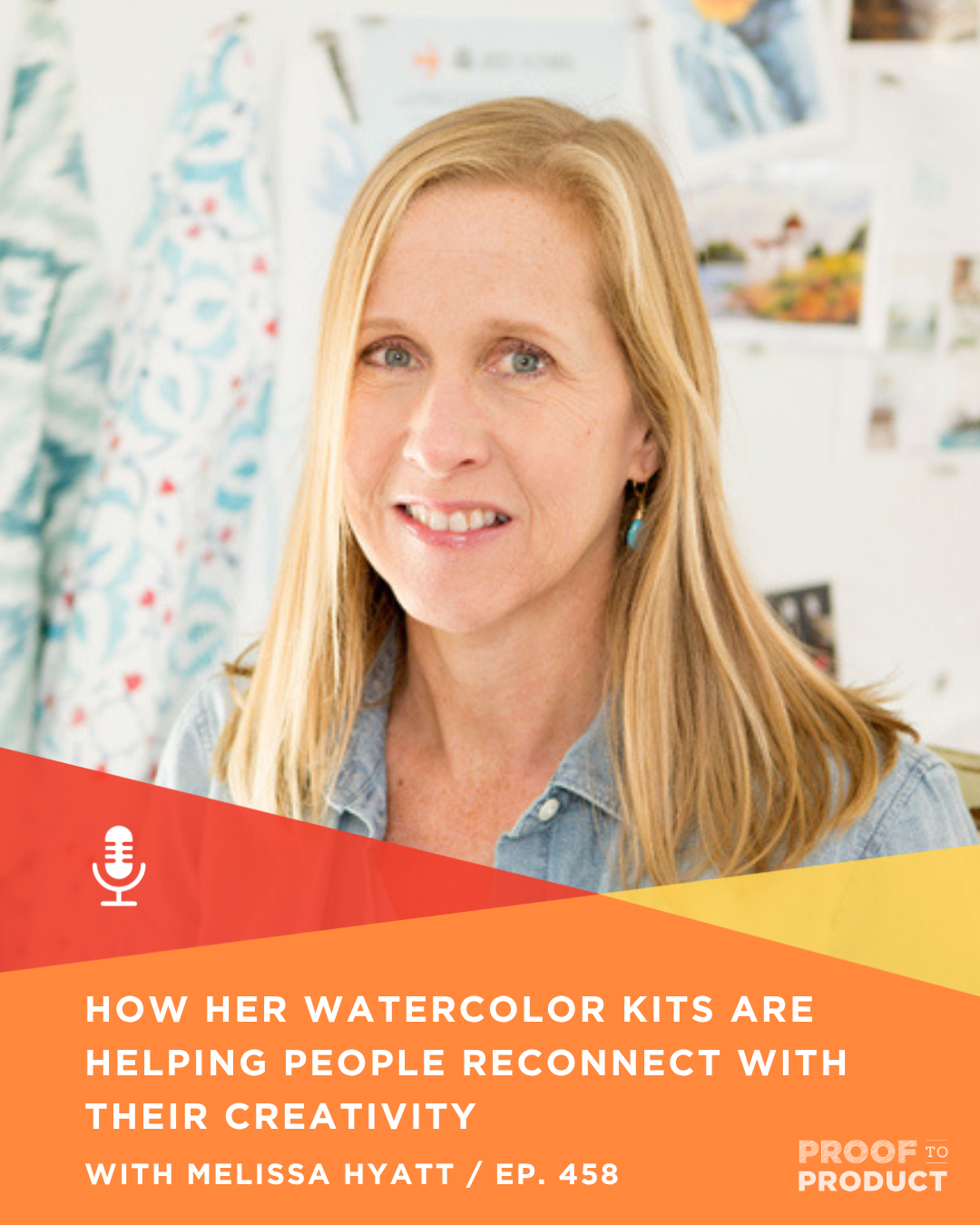
What happens when one client makes up 85% of your income, and then that client cancels the contract? For Melissa Hyatt, that moment became the reason she built a business with several ways to earn. Melissa shares her path from design director at Waverly Fabrics to running her own stationery and watercolor brand, and how a sketch on a piece of copy paper turned into a line of watercolor kits that has sold more than 1,000 units.
In this episode, you'll learn:
Why Melissa decided never to rely on one client again, and the five revenue streams she built instead: wholesale, teaching, licensing, art commissions, and direct-to-consumer
How her first wholesale account came from a former Waverly colleague's referral, and why the network you already have matters
Why she limits commissions and in-person classes to avoid burnout, and how that burnout led her to turn her teaching into a product
How adding a higher-priced product raised her average order value, brought in new types of stores, and led to in-store teaching opportunities
The inventory lesson from her first big trade show orders: she under-ordered brushes, shipped a few weeks late, and not one retailer canceled
your product brand right now?
MEET MELISSA
Melissa Hyatt is an artist and surface pattern designer based in Connecticut. After studying surface pattern design at Syracuse University, she spent more than two decades designing textiles, wallpaper, and licensed products in New York, including five years as design director at Waverly Fabrics. Today she sells coastal-inspired stationery, original watercolor art, and watercolor kits, and teaches watercolor workshops.
CONNECT WITH MELISSA
WEBSITE: www.melissahyatt.com | INSTAGRAM: @melissajanehyatt
Connect with Katie Hunt
Katie Hunt is a business strategist, podcaster, mentor and mama to four. She helps product based businesses build profitable, sustainable companies through her conferences, courses and coaching programs.
Website: prooftoproduct.com | Instagram: @prooftoproduct
-
Katie Hunt [00:00:00]:
Hey friend, welcome back to Proof to Product. Today's conversation is about building a business that truly evolves alongside your life and also having the courage to reinvent yourself more than once along the way. I'm joined by one of my clients, Melissa Hyatt. She is an artist, a surface pattern designer, an entrepreneur. Before launching her own product brand, Melissa spent more than 2 decades designing textiles, wallpaper, home decor, and licensed products for major brands in New York She eventually served as the design director for Waverly Fabrics. Today, she brings all of that industry experience and knowledge into her own business where she creates stationery, watercolor art, and beautifully created watercolor kits that are helping more people reconnect with their creativity. Now, in this episode, Melissa shares how her career evolved from the corporate design world to entrepreneurship, why she intentionally built multiple revenue streams in her business, and how one unexpected setback became kind of the catalyst for creating a business that's more resilient and also more fulfilling for her. We also dive into her wildly successful watercolor kits, the product development process behind them, and how following her curiosity has opened doors that she never really expected.
Katie Hunt [00:01:19]:
I really love Melissa's perspective on experimentation, perseverance, and creating products that create a meaningful impact in people's lives. If you've ever wondered whether it's too late to pivot or launch something new or reinvent your business, I think you will find so much encouragement in today's conversation. Today's episode is brought to you by our Is Wholesale Right for You workshop. Wholesale is not the only way to make money selling your products. You'll hear that from Melissa today, but it is definitely my favorite. Selling in bulk to retail stores that order multiple times a year instead of relying on one-off direct-to-consumer sales— yes please, give me more of that. So whether you are brand new to wholesale or you've hit a sales plateau, this free 25-minute on-demand workshop will give you actionable steps that you can take to strengthen your wholesale sales and marketing right away. So access that workshop at prooftoproduct.com/workshop.
Katie Hunt [00:02:14]:
Again, that's prooftoproduct.com/workshop. I'm Katie Hunt, wholesale expert, business strategist, and mom of 4. I'm also the host of the Proof to Product podcast. Since 2011, I've coached thousands of brands whose products can be found on the shelves of indie shops and big box stores all around the If you are a creative entrepreneur that makes and sells physical goods, you're in the right place. Here on Proof to Product, you'll learn new strategies for product development, sales, marketing, and more. It's like your weekly dose of business school, and we're going to help you confidently grow your revenue in your own way and at your own pace. So let's get started. Hey Melissa, welcome to the podcast.
Katie Hunt [00:03:03]:
I'm so excited to have you here.
Speaker B [00:03:05]:
Thanks, Katie. I'm happy to be here.
Katie Hunt [00:03:07]:
Well, I would love for you to start this off by sharing a bit about yourself and your business, and then we'll talk about how you got into all this. What do you sell and what products are you offering?
Speaker B [00:03:18]:
So stationery predominantly, but I've also launched within the last year watercolor art kits, which is a little bit of a DIY adventure that I dove into and has been doing really well. So stationery and art kits.
Katie Hunt [00:03:36]:
Awesome. And you have a very coastal theme and vibes, which was inspired by where you live, right?
Speaker B [00:03:43]:
I do. I've always been drawn to the water, and I didn't grow up living by the Long Island Sound. I live in Connecticut now. I actually grew up in Connecticut, but more inland. But there was always something like I loved going to the beach. When we would go to the Jersey Shore or go to Cape Cod, like it was always a place that I felt really comfortable. And after 25 years of working in New York City, we moved out to Eastern Long Island where it's all beaches and vineyards. And that's when I really kind of found my place.
Speaker B [00:04:16]:
Yeah.
Katie Hunt [00:04:16]:
You really settled in your style, your lifestyle, all of it combined. Okay. Well, tell us how you started this art business because you did work in New York doing art for other brands for a very long time. Did you always know that you eventually wanted to be an entrepreneur and on your own?
Speaker B [00:04:32]:
Listen, I didn't even know that I wanted to go to art school back when I was in high school. My art teacher kept telling me, you've got to go to art school. And I'm like, I don't know. I really was into like math and economics. And I'm like, no, no, no, I think I want to just do something more standard. And Mr. Shaw was his name. And he really just kind of insisted, go to portfolio reviews, go interview to these colleges.
Speaker B [00:04:55]:
I'm like, okay. So my dad took me around to a lot of different tiny art schools and I just felt like, this is not me. And then a really good friend of my dad's, we were at a hockey game. He was a school administrator, guidance counselor, and we started talking and he's like, what are you thinking? And I said, well, everyone thinks I should go to art school, but I don't know. He goes, pick a big university that has a good art program and then you can always change your mind.
Katie Hunt [00:05:20]:
That's great advice.
Speaker B [00:05:21]:
I loved that, right? It worked for me. So I ended up at Syracuse University and I did major in art.
Katie Hunt [00:05:28]:
You did?
Speaker B [00:05:29]:
I did. I did. And I just fell in love with it. I loved the program, and I loved the people I met and my instructors. And I kind of felt like, oh, maybe I'm finally finding my place. And I fell into a major called Surface Pattern Design. So at the time, I didn't even know what that was. And one of my professors sent me to the department, and I went and I looked, and I thought, wow, it's color and it's pattern.
Speaker B [00:05:55]:
This is really interesting. And so, I applied to the department and was accepted and majored in surface pattern design. So, when I graduated, I moved to New York City and I worked for a big textile company designing wallpaper and fabrics. I bounced around a bit. I freelanced for a bit. I worked corporate for a couple of years, freelanced. I liked being on my own, but there was a little uncertainty about, like, where the next paycheck was going to come from. And I was pretty young with a pretty big rent to pay.
Speaker B [00:06:23]:
But I love the creativity part of it. So I went back to corporate for a few years, bounced back to freelance. And along the way, I think I was kind of exploring. I was designing wrapping paper and cards, a lot of fabric and wall coverings too, but wall art and calendars and china and you name it, we were designing it. And so that really opened up my eyes to all the different things you could design. I found out a lot about licensing as well, which I ended up kind of turning towards that. But eventually, I had a client that was a really big part of my freelance business. It was Waverly Fabrics.
Katie Hunt [00:07:05]:
Mm-hmm.
Speaker B [00:07:06]:
And I would go and I'd work in studio with them. And one day, I'm sitting at my desk, I have my headphones on, I'm drawing, I'm painting. The president of the division comes over to me and she's like, can you come to my office? I'm like, oh, God, what did I do? But she pulls me in.
Katie Hunt [00:07:21]:
Your heart must have just dropped, huh?
Speaker B [00:07:23]:
Yeah. And she's like, listen, we're having some changes within the department. And there's a design director position that's opening up. And I think you would be great in this position. And I was just like, what?
Katie Hunt [00:07:37]:
OK, that's not what I was expecting.
Speaker B [00:07:39]:
I was expecting, like, see you later.
Katie Hunt [00:07:42]:
That's amazing, Melissa.
Speaker B [00:07:43]:
So she's like, yeah, I don't want you to answer me right now. This is what it would be. This is the job. Think about it. Get back to me. Let me know. But you're my number one choice. I'm like, OK.
Katie Hunt [00:07:52]:
How amazing.
Speaker B [00:07:53]:
Yeah, so I went home. And I was just like— I was kind of blown away. I really liked my freedom. So I knew I'd have to give that up. But I also knew that the experience I was going to get with this company was just going to be amazing. So I did make the decision. I took the job. And I stayed there for about 5 years.
Speaker B [00:08:12]:
I was design director for the entire fabric line. And then I took over wall coverings at one point. And I oversaw a studio. I had a staff to manage, and I traveled a lot, and I printed at the mill, and it was great. It was a really good experience.
Katie Hunt [00:08:26]:
Yeah.
Speaker B [00:08:26]:
In the meantime, I got married, and I was pregnant with my first son, and I knew the demands of that job wouldn't allow me to be able to really raise my son, and that was important to me. So I was kind of torn during my maternity leave, but in the end, I thought, I waited this long to have kids, and I want to be able to spend as much time as I can with him. So I left the job and then we moved out to the end of Long Island, you know, where I talked about before. Yeah, by the beach.
Katie Hunt [00:08:55]:
Wow, what an incredible story. I have to imagine all of those years in corporate have lended themselves well to you now running your own business. You learned so much on the job about product design and development and manufacturing, as well as like the operational side of things. Do you feel like that's really helped you in your business?
Speaker B [00:09:15]:
Absolutely. I think it really prepared me to talk to mills when I'm working on a new product and just correspondence and just understanding the processes, working with people, and really being able to jump from the demands of the financial part of it to the creative part of it and just finding the balance in between.
Katie Hunt [00:09:41]:
Yeah.
Speaker B [00:09:41]:
Yeah, I think it really did. I feel like every step along the way taught me something that I could bring to form this business that I'm actually doing now. I sometimes wish I didn't wait so long to launch my own business, but I feel like everything I learned along the way has helped me really position myself, be confident in who I am and my voice and what I'm doing, and to help me move forward. But I mean, I'm learning every day.
Katie Hunt [00:10:07]:
Right? Same.
Speaker B [00:10:08]:
Absolutely. I always say, if there's anybody that's affiliated with a university with an art program, I'm like, you need to have a business class for art majors. It really would've been so helpful to kind of know a lot of the things I've learned by research, hard work, taking classes, hiring coaches, you know, doing all the things that I've done because yeah, there's so much that I didn't know.
Katie Hunt [00:10:32]:
Yeah. And that's true for all of us, right? I feel the same way. I'm learning new things every day. The industry's changing and evolving. The way we do business is changing and evolving. But I love this story of Adaptation, really. Okay. So you retire from corporate, you're home, you have your son.
Katie Hunt [00:10:48]:
Did you start doing freelance work right away? And was it more of the same of what you had previously been doing, or was it slightly different? Because you weren't in product quite yet, right?
Speaker B [00:10:56]:
Now, that's a great question because what happened was I thought, yes, I'm just going to be this. I'm taking care of my son. This is what I'm going to do. But I found like I really missed it. I really missed the creative part. And the company I'd worked for reached out and said, will you take some freelance Like, we really need help.
Katie Hunt [00:11:12]:
Mm-hmm.
Speaker B [00:11:13]:
And so I thought, okay. So basically my son would go to bed and I'd go into my studio and I'd work late nights still designing for fabrics and wall coverings. And it was a lot of stuff I was doing was hand-drawn, hand-painted. Things were starting to shift. Things were already shifting to CAD. So I made the investment and I bought a CAD system that I could design for fabrics and wall coverings and color. And thought, okay, I get to do this kind of on the side. And I did.
Speaker B [00:11:43]:
I designed a couple wall covering books for a few companies. I freelanced with Waverly, and then I got pregnant with my daughter. And suddenly I've got a 4-year-old, almost 4-year-old, and now a baby. And, you know, I was like pregnant at the mill putting wall coverings. So like trying to like work it all in. Which I loved the flexibility that I could do that, but I kind of then hit the wall. It was too much. So I did step back for a bit.
Speaker B [00:12:13]:
But in that time, like, I felt like something was missing. And I'm like, I loved working. I love being a mom. I adore my children. Like, something's not right. I started scrapbooking, trying to find a creative outlet. And then I saw an ad for a watercolor class at my local library. And I'm like, you know what? I'm doing this.
Speaker B [00:12:33]:
And I had no brushes, no paints. I hadn't painted since college and got all my new art supplies. I felt like a kid on my first day back to school and showed up at the library with all my gear. And this instructor was— she was amazing. We were painting like flowers and birds. And I sat down and I did my first sketch and I'm mixing up paint and she comes over and she's like, Wow. She's like, do you do this all the time? I'm like, no, I haven't done this since college. She's like, okay, well, I'm glad you're here today because you need to do more of this.
Katie Hunt [00:13:07]:
Oh, I love that encouragement.
Speaker B [00:13:09]:
And I was like, okay. Yeah, yeah, it was cool. And then I, for years, I studied with her, would go to her house for classes and whenever I could, and really worked on my own. I was just— it was like this door opened up and there was like this Technicolor world, this bright colored world of watercolor that I just fell in love with it.
Katie Hunt [00:13:30]:
Yeah.
Speaker B [00:13:30]:
And realized pretty quickly within a few years, like, how can I marry this new love with my business, with the surface pattern? And I got asked to do a designer showhouse in my town. It was a fundraiser and they basically asked local designers to take a room and you transform it. And so I thought, okay, this is a great opportunity. I could showcase my art. I did prints of some of my early pieces. I printed my own fabric. I did a hand-painted rug on the floor. And it was like everything in this kitchen, it was like either from me or some of my art was on the wall.
Speaker B [00:14:09]:
I used my fabrics to like upholster the chairs and—
Katie Hunt [00:14:12]:
That is so cool.
Speaker B [00:14:13]:
Just kind of like helped me launch my brand. And so That was sort of the beginning in like 2016. And then from there, it was like sheer determination. I was like, I am going to do this. I've done this for everybody for so many years and now I want to do my own thing. I got a little taste of it and I'm like, this is it.
Katie Hunt [00:14:31]:
Yeah.
Speaker B [00:14:32]:
And so then, yeah, I was just trying to figure out where to go. And very organically, I feel like my business grew. A local card shop reached out to me and she said, you were recommended to me by a friend of mine. from Brooklyn. I used to work with him at Waverly when I was in the city. And he's like, my friend Melissa does watercolors on Long Island and she's in your town. And so she reached out. She was my first wholesale account.
Katie Hunt [00:14:55]:
That's amazing. You never know where these opportunities are going to come. That's incredible.
Speaker B [00:15:00]:
Totally crazy. And I have an order for her and I'm heading to Long Island tomorrow and I'm going to deliver another order to her. She's a really dear friend and great customer. So from there I thought, oh, wait a minute, maybe there's other opportunities. I was doing a lot of direct-to-consumer, all my prints on my website, and I would do pop-up markets. And then so I was testing the water with wholesale here and there. In the interim of this time, I went through a divorce and now I'm on my own. And so, you know, I had all these responsibilities of my kids and taking care of myself.
Speaker B [00:15:33]:
And it was like—
Katie Hunt [00:15:34]:
Yeah, you need it to work. Yeah.
Speaker B [00:15:36]:
Yeah. So again, I think it's that the word determination just like keeps coming back into my vocabulary. And I was like, I was determined to show my kids, you can do what you love, and it may not be easy, but you can find a way. It's like, let's do this. And so my daughter is very entrepreneurial. Her beading setup is right behind me here, and she's got a really successful Etsy shop, and she's a content creator. She's very good with film and digital and editing. And so she'll say to me, she's like, Mom, When you did whatever the thing was, she goes, I remember that.
Speaker B [00:16:10]:
And I thought I could do what I want to do and be creative. And so I love that.
Katie Hunt [00:16:15]:
This is such a good example of how these kids watch us and mirror us. And without us even realizing it, probably you're instilling this work ethic in her. And also that belief, like you said, of you can do whatever you want and you can make it successful if you just want it. If you're willing to do the hard work and continue through with seeing it through.
Speaker B [00:16:37]:
I really think like passion can carry you a long way.
Katie Hunt [00:16:40]:
Yeah.
Speaker B [00:16:40]:
There were points where it was like not enough money was coming in and I'm like, oh God, I'm gonna have to go get a full-time job. I interviewed for this job with like this carpet company designing carpets and I would have had to have commuted like an hour and a half.
Katie Hunt [00:16:54]:
Oh no.
Speaker B [00:16:54]:
And on Long Island, going an hour and a half on the Long Island Expressway, it's like, oh my God. I was like in tears just thinking about it, but I was just like, what can I do? for me to not have to take this job that was just gonna probably just crush me creatively, right?
Katie Hunt [00:17:08]:
Yeah.
Speaker B [00:17:09]:
So I pivoted, and that's when I really started to dive into building my product business.
Katie Hunt [00:17:15]:
Yeah.
Speaker B [00:17:16]:
So—
Katie Hunt [00:17:16]:
That's incredible. I love this backstory, Melissa. Like, I've known pieces of it, but hearing you tell it, it's just really beautiful.
Speaker B [00:17:22]:
You now—
Katie Hunt [00:17:23]:
let's talk about your business now. You now run multiple revenue streams. Wholesale's a big piece of it. You do some teaching. You have licensing, like you mentioned. You do art commissions. You do direct-to-consumer. Did you build all of those? And sometimes I'm always telling you, we got to narrow down, right? We got to focus on a few, but like, I also feel like every time you and I talk about this and friends listening, Melissa and I work together closely.
Katie Hunt [00:17:47]:
She's one of my coaching clients. So just for context there, but you have an interest in each of these revenue streams. You did not go into these revenue streams blindly, but was there like another reason? Did you just want to anchor down on diversification of revenue streams? Do you just have multi-passionate interests in all of these things? Like what was kind of your intent there? Yeah.
Speaker B [00:18:05]:
The turning point for me really was when I was strictly working in my textile business. So this was, I guess, right before I did the Designer Showhouse, just kind of around that time. I was very dependent on my freelance income, and it was all computer work, and it was for— there were 2 customers that I worked for freelance.
Katie Hunt [00:18:27]:
Okay.
Speaker B [00:18:28]:
One of them was like 85% of my business. And I would go to the mill and print for them. I would also go into the city and work in their studio, and I would work from home. And so literally one day, I was supposed to go up to Rhode Island to print. There's a fabric mill up there that I would go to print for them. And the week before, they were like— I checked in and I'm like, I need to book my hotel and get ready for this, like, whatever. And they're like, we don't know what you're talking about. So a misunderstanding.
Speaker B [00:18:56]:
I thought they booked me. They didn't think they booked me. And this whole thing ensued. And I was just like, well, listen, you booked my time. And I had the emails that backed it all up. Like, they asked me to book my time. And so, when someone cancels on you like that, you charge them what's called kill fee.
Katie Hunt [00:19:13]:
Yeah.
Speaker B [00:19:13]:
So, I charged them the kill fee. And they didn't like that. I think it was the assistant's fault. You know, I had a great rapport with the design director, but I think I basically got thrown under the bus and I got blamed for everything. And they never paid the kill fee and they never booked me again or worked with me or freelanced with me again. So that was 85% of my income. And now I've got 2 kids.
Katie Hunt [00:19:35]:
Oh my gosh.
Speaker B [00:19:36]:
And a house. And I'm like, so sitting there in that moment, I thought, I never want to be in this position again. Yeah, I need to find more balance and not be so dependent on like one thing. So yeah.
Katie Hunt [00:19:50]:
So that's when you started experimenting.
Speaker B [00:19:52]:
Yeah, the product, the direct-to-consumer. I have a very strong business. Like, my wall art business just became, you know, like a big part of what I was doing and the pop-ups. And then I had an art show. I sell a lot of my original art, framed original art too. There was a restaurant in the town I used to live in that would feature different artists. So she asked me to hang my art and I was honored. Yes, I'd love to.
Speaker B [00:20:15]:
And then I came in and she said, we'll usually do like an opening for the art. exhibits. And I said, okay. I go, well, what do you think if I did a watercolor workshop instead? Okay, I don't know who told me to say that, but I love— I didn't walk in there intending to say that, and it came out of my mouth and I went, oh my God. And she's like, I would love that. I'm like, oh my God. So that was my first class, and I've probably taught, I don't even know how many, hundreds, hundreds and hundreds of watercolor workshops, but that was my number one.
Katie Hunt [00:20:46]:
And I love that you shoot your shot. Oh my God.
Speaker B [00:20:50]:
And it was like super organic. Like it just happened. And the owner of the restaurant, I went on to do probably 8 to 10 classes there. And she came up to me about midway through and she said, I have to tell you that I have paint nights at my house. My husband now paints. My friends come over. I have watercolor supplies for everybody. She goes, you've inspired us.
Speaker B [00:21:11]:
Like instead of going out drinking and going to the bars, we have paint parties and it's all because of you. And I was like, Oh my God.
Katie Hunt [00:21:17]:
So that's amazing, Melissa. Okay. So it sounds like that consulting gig was a rough situation. I'm sorry that happened to you. And also for it to fall apart over miscommunication just bums me out because things happen. But also I love how you talk about how this sparked all these other things. You know, it pushed you further into product. It pushed you further into the direct-to-consumer thing.
Katie Hunt [00:21:38]:
You spontaneously offered to teach a class, which has then gone on to be a big part of your revenue streams and your commissions too, with your art on the walls and selling those originals. That was a good revenue stream. It still is a good revenue stream for you. Curious, which one is your favorite? Oh, I'm gonna ask you to pick a favorite child right now.
Speaker B [00:21:57]:
Just kidding. You know, I do love when I can paint, and I feel like when I do commissions, I'm gonna be painting. So I do have a sweet spot. I have a love for it. I just try not to take on too much because then it's not fun anymore and it becomes too stressful. So I'm very careful. I limit the number that I take, but I do love commissions. And my favorite child now is pretty much growing my wholesale business.
Speaker B [00:22:21]:
I've just become like really obsessive about it and it just really works for my lifestyle and I'm really loving it. So.
Katie Hunt [00:22:27]:
Well, I have to tell you, especially being on the inside of your business, you've been so intentional with your wholesale growth and how you're connecting with your customers, the product assortment that you're putting to market. I am not shocked at all that your revenue has grown so much on the wholesale side because You're excellent at it and you're really— that grit and tenacity, the determination we talked about earlier, you've definitely poured that into all of your work in wholesale over the last couple years that we've worked together more closely. I would like to talk about your art kits a little bit more. I know you teased those a little bit at the beginning. Last year you launched a new product, these art kits, and listeners, they have been wildly successful. Melissa put a lot of great care and thought into really the research and development phase. I felt like We spent a lot of time kind of honing in on what the product would look like, what the packaging would be, what you would include, how you would make it easy for the customers to utilize it and share it with others. And I was curious, are you open to sharing a little bit about what that process of developing the product was like without giving away anything that's proprietary or anything? But what did that process feel like to you and, and what are you proud of?
Speaker B [00:23:40]:
So I think to kind of start from the beginning for me was I was teaching a lot of classes in person. I do a lot of private lessons as well. And around the time you and I really started working closely together, I was just burned out.
Katie Hunt [00:23:53]:
Yeah.
Speaker B [00:23:54]:
I was teaching so many classes and I just was like, I can't even book another one. It was just— it was a lot. And so I kept thinking about ways that I still want to reach people and help them explore their creativity. So how can I do that? So I started doing videos on Skillshare. I have a couple classes up on Skillshare. And, but I struggled. It was like the tech part of it. It was like I always had an issue with like the taping.
Speaker B [00:24:23]:
We were talking before, there was an air conditioner running in the background and I had to refilm an entire class. Like, just, it kind of was a struggle. And they took my class down because of that. And then the guy next door was like mowing the lawn and it came up like really low in the back. And it was like one thing after another. And I'm like, okay, this is not helping me reach more people. What can I do? What can I do? And I thought if I could get something into people's hands that actually have the paint and the brushes and give them all the instruction they need, like written plus a video, they could be in a class with me and the paper and everything, like make it as easy as I can. I think that there was a need in the market for that because there were a lot of other options out there, but—
Katie Hunt [00:25:04]:
Yeah.
Speaker B [00:25:04]:
They maybe didn't have a complete package. So that was important to me. So yeah, it was just kind of like this little thought in my brain and I started playing around with it and then shared it.
Katie Hunt [00:25:16]:
Advisory board loved it. We loved it.
Speaker B [00:25:19]:
And I was like, what do you guys think? And everyone's like, this is amazing. I'm like, oh, okay, good, good, good. And yeah, it's grown from there. I just launched, I have 4 new kits just coming out. So I have a dozen now, different designs.
Katie Hunt [00:25:31]:
Amazing.
Speaker B [00:25:32]:
And it's been a great journey. And it's— I'm not going to say it's easy because there's challenges with every— like, I had issues with the production of the packaging, and then we had a problem uploading the videos and finding someone to help me do the videos. And, you know, it's just like all these different things come in. And then when it's humid, like, the paint starts to stick to the paper. Like, how do I package them so it doesn't happen? You know?
Katie Hunt [00:25:57]:
Yeah. We talked about that in the process of all the little things. When you do something like that, that's a kit, it does require a lot more steps in the production of it. Even the marketing of it is different than just a one-off type product, like a greeting card or a mug or a candle or something like that, right?
Speaker B [00:26:17]:
Yeah.
Katie Hunt [00:26:17]:
I will say that adding this kit came at a really great time where people are seeking more analog, offline, community-based activities, and I think you've done an incredible Job of I don't want to say riding that wave because I think this is an evergreen product that's going to serve you well for the long term, even though right now it's more it's fitting into this trend that's kind of popping up. But I will also add that adding a higher price point product to your wholesale collection, I feel like it's expanded the types of stores that you're connecting with and that you're working with and reaching out to. I feel like it's increased your sales volume; it's increased your average order value. I think that it's also opened you up to more in-store. teaching opportunities. So I guess my question— one, I'm framing all these successes that have stemmed from this one product, but were you surprised by any of these opportunities that came about?
Speaker B [00:27:10]:
Yeah, I was kind of blown away by the whole thing. I launched them right before my first 2 wholesale trade shows, which— yeah, no, my first one, sorry, it was in the fall. And I was like scrambling to get them done for that. And it was the New England Made Show, which you have to be a New England resident to be able to apply to the show. It's juried. I got accepted and I was like, okay, I need to make a splash and I got to bring these kits. And people went crazy. And they have a contest where you enter a new product, then the buyers that come vote on it for their favorite product.
Speaker B [00:27:46]:
And I got like honorable mention for best new product.
Katie Hunt [00:27:49]:
Amazing. That was also the show where you won best booth design too, right? Didn't you win an award for your booth design?
Speaker B [00:27:56]:
In the spring. Yeah, the same company, but it was, yeah, the spring show. Yeah. So I was just like, oh my God. Like when I saw my kit sitting on that thing, honorable mention, I was like, oh my God, what is going on?
Katie Hunt [00:28:08]:
That's validation, Melissa.
Speaker B [00:28:10]:
It was crazy. It was, it was great. It was great. And then when I did the shows, I did 2 shows in March then, and I had 4 new designs come out. So that was 8 total. And I had no idea that I was going to sell the number of kits I sold. I didn't order nearly enough brushes. So I'm learning a lot about inventory.
Katie Hunt [00:28:30]:
Yeah.
Speaker B [00:28:31]:
And I'm like scrambling to get more brushes. And I thought, oh, people are going to be so upset because I promised them they'd have it. It was like by the end of the middle of April or something, and I was delayed a few weeks and everybody was— nobody canceled their order. Everyone was like, it's fine, Melissa, don't worry about it. Just get them when you can. Yeah, we're so excited for this product. And Yeah, it all worked out, but it was just, I was blown away. Like, I've sold over 1,000 kits now.
Katie Hunt [00:28:55]:
I know.
Speaker B [00:28:56]:
And I just was like, oh my God, like, what?
Katie Hunt [00:29:00]:
This was an idea a year ago and now you've sold over 1,000 of them.
Speaker B [00:29:05]:
Yeah, like I sketched out, I was traveling and I had like a piece of copy paper with me and I started drawing in black and white art kit ideas, contents. And I have the sketch still to this day.
Katie Hunt [00:29:18]:
Oh my gosh, you gotta put it on the wall in your office.
Speaker B [00:29:20]:
I do. I found it when I was moving. It's packed in a box somewhere over there. But I was like, oh my God, that was the brainchild. That was the beginning. Like I was drawing out, it has to have all these things in it. It was like a blueprint for it. And I was like, oh my gosh, there it is.
Speaker B [00:29:34]:
And now it's like real. So.
Katie Hunt [00:29:36]:
I also want to mention here that when you first brought this idea up to me, I was a little bit wary. I'm not going to lie. I was a little bit like, Melissa, this is a big project. There's multiple components to this. Like, We spent a good amount of time talking through the logistics, the packaging, you know, because we wanted to make sure that you were investing your money in the right places and the product development budget and all this stuff. And I had no doubt that you would do an amazing job with this because all of your products are so well done and the thought behind each is great. But it was more of like a circumstantial where you were in your business and it was like, let's take the leap. Let's do it.
Katie Hunt [00:30:13]:
Let's like try. And I've just been so impressed with not only what you created, but how you're talking about it, how you're marketing it, the response people have had, and also the overarching impact that it has had on your business. I mean, it has really opened up a lot of doors. I know I mentioned some of these things, but it's opened up opportunities for you. And I think I just want to commend you on, again, that grit, determination, the willingness to take risks. I think there's a lot of people in our community that would have been like, oh, this is too complicated, we're not going to do it, you know? And you were like, no, I believe in this and I want to do it. And I commend you for that for sure.
Speaker B [00:30:51]:
Thank you. I think overall it was just— I know what finding my creativity again when I took that watercolor class, I know what it meant to me and how it just radically changed my life. And I hear so many stories from so many people how it's changed things for them, how even taking one of my classes, they'll come back to me and say, you know, I was going through a really tough patch and then I did that class with you. And then I bought watercolors. And now, like, when I'm feeling, you know, lonely or depressed or whatever, I start painting and I feel better. And I just feel like there are so many people out there. If I could touch more people in that way and, like, really help them, that just gives me, like, purpose. And it's not just about me making a kit and making money.
Katie Hunt [00:31:39]:
Right. It's about the greater impact.
Speaker B [00:31:41]:
Yeah. I just know there's just so much, like, healing that could be done and people that are just in need of something. It sounds so simple, but it just escaped for a while. And why not? In this world, it's like we all need somewhere to go. So if my kit can do that, like, it makes me happy. So—
Katie Hunt [00:31:59]:
Oh, Melissa, I love that. I love that. All right, share with our listeners what is next for you. Is there anything you're working on that you want to share with them, or anything coming up that you want to promote?
Speaker B [00:32:10]:
I am, you know, just continuing Reaching out really with my art kits. I've had a lot of requests lately for teaching, so I have to be really careful. I'm not going to overcommit myself because I learned the hard way. I don't want to burn out. But yeah, I just want to continue to like share my watercolor, share the love for it. I'm always happy to answer questions from people that are trying to figure it out. So yeah.
Katie Hunt [00:32:34]:
Awesome. All right, well, let's tell the listeners where they can find you, your work, where they can shop your products and follow you on social. What are all your links?
Speaker B [00:32:41]:
So you can find me on Instagram. I'm @melissajanehyatt, and my website is melissahyatt.com. And those are really probably my 2 big hubs for sharing my work and all of that.
Katie Hunt [00:32:57]:
Awesome. We will include those in the show notes so people can easily find you. Melissa, it was such a joy to chat with you today. Thank you so much for being here and sharing your story.
Speaker B [00:33:04]:
Thanks, Katie.
Katie Hunt [00:33:06]:
Okay. I hope you enjoyed this conversation with Melissa as much as I did. I really admire how just her tenacity, she's never been afraid to evolve, whether it was leaving corporate or rebuilding after that challenging client that let her go or launching an entirely new product category. She really continues to trust her creativity while also being thoughtful about the business decisions that she's making. So if you would like to learn more about Melissa and shop her beautiful stationery and her watercolor kits, or just follow her work, you are going to find all those links to her socials and her website in the show notes. So I'll also include her watercolor kit link directly in the show notes because it's a great activity to do with family, friends, even team building in a business. We did them at a recent advisory board retreat. We spent one night after dinner like painting and it was just so much fun and it was kind of a test mode.
Katie Hunt [00:34:02]:
We were like giving feedback on the product and everything, but it was great and I highly recommend them. So. Also, if you are ready to grow your wholesale business with more intention, if you're looking to expand that wholesale sales ecosystem, I would love to support you inside of Paper Camp. Whether again you're just getting started with wholesale or maybe you're looking to build stronger systems that increase your sales, Paper Camp is going to give you the strategy, support, and community to help you get there. So you can learn more and join the waitlist at prooftoproduct.com/papercamp. That's prooftoproduct.com/papercamp. Product.com/papercamp. All right.
Katie Hunt [00:34:35]:
Thanks for hanging out with us today. I'll be back soon with a new episode.
How do you decide what to make next, what to cut, and where to put your limited time and money? For Elizabeth Rees, founder of Chasing Paper, the answer has come from her customers for nearly 13 years. In this week’s podcast episode, she shares how customer feedback shaped her product format, her materials, her wholesale approach, and her newest line, and why she checks every instinct against the data before acting on it.