298 | Wholesale Minimum Order Amount: Why You Should Never Accept a $25 Wholesale Order

Should you accept a wholesale order for $25?
The short answer: No, a $25 wholesale order likely costs you more to fill than it pays you. Add up your cost of goods, your packing materials, and the two hours it takes to confirm, pull, pack, label, and ship it, and you're about $6 in the hole. Wholesale is a volume game. Your opening order minimums serve several purposes — they make it worth your time to fill, it helps the buyers make their buying decisions and ensures stores have a wide enough assortment of your product to merchandise it well in their store. Minimums are not a barrier for shops, they are a benefit. And, the right shops know that.
“Maybe they’ll buy more next time if I say yes to a low minimum now?”
You get an email from a store that you’d love to work with. They want to place a wholesale order. But only a few things. Three of this, four of that. Maybe $25 worth.
Red flags are flying, but everything in you wants to say yes. You’re flattered that they like your work. You want to work with more stores. Maybe they’ll see how great the product sells and then buy more next time! You’re just so excited at the opportunity.
Saying no feels uncomfortable, maybe even rude. Telling them they need to add more to the cart in order for you to process the wholesale order feels awkward, too.
So you fill the order. And it feels like a win, because an order is an order.
But that order didn’t just make you a little less money than a bigger one. It likely cost you money. You paid for the privilege of filling that order so that you could say that you could add one more store to your number of stockists.
That’s not a business mindset problem or a confidence problem. It’s a math problem. And, once you see the numbers, sayin no stops feeling rude or uncomfortable… and you start making better decisions for you and your business.
Why do wholesale minmum orders exist?
I got an email from a podcast listener named Jennifer:
“I understand that there are conventions and industry standards when selling wholesale—particularly minimum opening order amounts, minimum reorder amounts, and minimum order quantities, but I want to understand why these things exist.”
Jennifer is working with 34 independent shops and most are asking for a lower opening order amount and a lower minimum order quantity. Jennifer also said she’s feeling pressure from Faire to lower her opening order amount to appease the algorithm.
Jennifer’s question really boils down to two things: why do the standards exist and whether she should adjust her line.
Let’s do the math first, because everything else flows from it.
The Math On A $25 Wholesale Order
Order Value …. $25.00
Cost of Goods: -$6.00
Packing Materials: -$1.00
Labor Time: -$24.00
Net: $-6.00
You lost six dollars.
Possibly more. To keep this simple, we didn’t include Faire fees, sales rep commissions or other potential expenses.
And, I was generous in the math here. I used $.60 COGS — yours may be higher. I used $12 per hours for labor and most of our community is paying $12 - 18 per hour for fulfillment help. I counted two hours of labor, which is conservative once you count everything that is actually involved:
Confirming the order
Pulling the product
Packing the product, if needed
Packing the box
Printing the packing slip
Printing the shipping label
Taping it up
Sending the shipping notification
Calling for pick up or driving to the post office
This also doesn’t include your overhead…. the studio space, website, time spent designing, accountant. None of it. The $6 loss is before any of the real cost of running your business.
You should be making a profit on every single order that goes out the door. Not most of them. Every. Single. One.
IS A $150 OPENING ORDER TOO HIGH?
This was Jennifer’s other worry. That a $150 opening order would be a barrier that keeps small shops from ordering from her.
No, it is not too high. A $150 opening order requirement is a low and reasonable wholesale minimum. Many independent shops are buying well beyond that.
Minimum opening order amounts protect your margins, your production time and your sanity. Wholesale order minimums signal to buyers that you run a real wholesal business and help guide their buying decisions.
In fact, order minimums make a shop owner’s job of buying easier — they know how deep they need to go in a line and they have guidance on how much of an assortment they need to increase sell-through rates.
Your wholesale terms & conditions set expectations for buyers and also boundaries for what makes financial and smart business sense for your businesses.
Your specific minimum will vary depending on your price points and how many SKUs you offer. A brand selling $2.75 cards and a brand selling $48 ceramics should not have the same opening order.
This is the math we run with you in Paper Camp. We’ll show you how to set an appropriate opening level based on the products you sell, your average price point, the size of your product line and industry norms for your segment.
Not sure whether your wholesale opening order minimum is what's slowing your wholesale sales down?
Take the 2-minute Wholesale Quiz and let's find out what's actually in your way.
Should You Follow Industry Standards for Wholesale?
First and foremost, this is your business. You can set whatever rules you want… what you make, how you sell it, what your wholesale terms and conditions say.
The caveat: minimums that don't align with industry standards are a red flag to buyers.
This typically surprises people. You'd think a lower minimum reads as an easier yes from buyers. To a buyer, though, it reads as that you’re new.
It raises questions about your product, your professionalism, your industry knowledge, and your experience. And, it makes the buyer wonder why you're not doing what everyone else does.
Buyers are busy and they want easy. When a brand doesn't meet industry standards, it adds friction and creates questions. They have to stop and figure out why you're different. Sometimes they just… don't.
It doesn't mean they won't ever buy from you. It means you'll have a harder time getting and keeping their attention.
Industry standards exist for a lot of reasons, and most of them come down to setting you and your stockists up for success.
Do I Need Wholesale Terms & Conditions?
Yes. But not for the reason most people think.
You want to make it easy for buyers to purchase from you AND you need every order to be profitable.
Your terms & conditions are how you hold both. They set expectations for buyers, guide their buying decisions and set you both up for a strong long-term relationship.
Terms & conditions also set boundaries around what makes financial sense for your business.
Without them, every order becomes a negotiation and you’ll be making the decisions on the fly, when you’re tired, flattered that someone asked or needing a cash influx.
My rule: Be stricter in writing, and flexible in practice.
What to Say When A Shop Asks You to go Lower
You don’t need a confrontation. But it helps to have a one-liner to lean on.
When they ask to order less than your opening order amount:
"My opening order minimum is $150, I’d be happy to recommend some additional best sellers or a wider assortment to get us there.”
When they want to order with lower minimum order quantities (ex. 3 instead of 6):
"All of our greeting cards are sold in increments of 6. If you're not sure which designs will move, I'm happy to recommend our best sellers so your first order is a safe one."
When you actually do want to make an exception:
"I don't normally go below my minimum, but I'd love to have you as a stockist, so I'm going to make an exception on this first order. Going forward my minimum (quantities or order amount) will apply."
All three hold the line, then immediately hand them a way to say yes. You're not rejecting them. You're helping them place an order that works for you and will benefit them.

Quick Recap:
A $25 order isn't a small profit — it's a loss once your time is in the math
A $150 opening order is a small order to most shops, not a barrier
Set your minimum by costing your actual fulfillment time, not by guessing
Minimums below industry standard signal inexperience to buyers
Be strict in writing, flexible in practice
When you hold the line, always offer a path to yes
Also mentioned in this episode:
Frequently Asked Questions:
Is $150 too high for a wholesale opening order? No. In most product categories, $150 is on the low end. Whether it's right for you depends on your price points and SKU count. A brand selling $2.75 greeting cards and a brand selling $48 ceramics shouldn't have the same number.
Should I ever accept an order below my minimum? Sometimes, on purpose. A dream account or a shop you're strategically building toward can be worth an exception. What you don't want is bending by default, order after order, because saying no feels uncomfortable. This should be the exception, not the rule.
What if a shop wants to order in smaller Minimum order quantities? Increments exist for pricing, packing and merchandising reasons, not to be difficult. Holding at your MOQ while offering to recommend your best sellers usually solves the real worry underneath, which is "what if these don't sell."
Won't a lower minimum get me into more stores? It'll get you more orders. Whether it gets you more profit is a different question. And to a buyer, a below-standard minimum often reads as inexperience rather than a deal.
Is Your Minimum Really the Problem?
Order minimums are one piece of a much bigger wholesale ecosystem. Sometimes slow wholesale sales aren't about your minimum at all. Somtimes it's your pricing, your wholesale catalog, your outreach, or the follow-up you're not doing. And you can lose a whole season fixing the wrong thing.
The Wholesale Blind Spot Quiz is a 7-question audit that pinpoints the one thing holding your wholesale sales back right now, and gives you a clear next step to fix it.
Seven questions, about two minutes, and you get your result immediately.
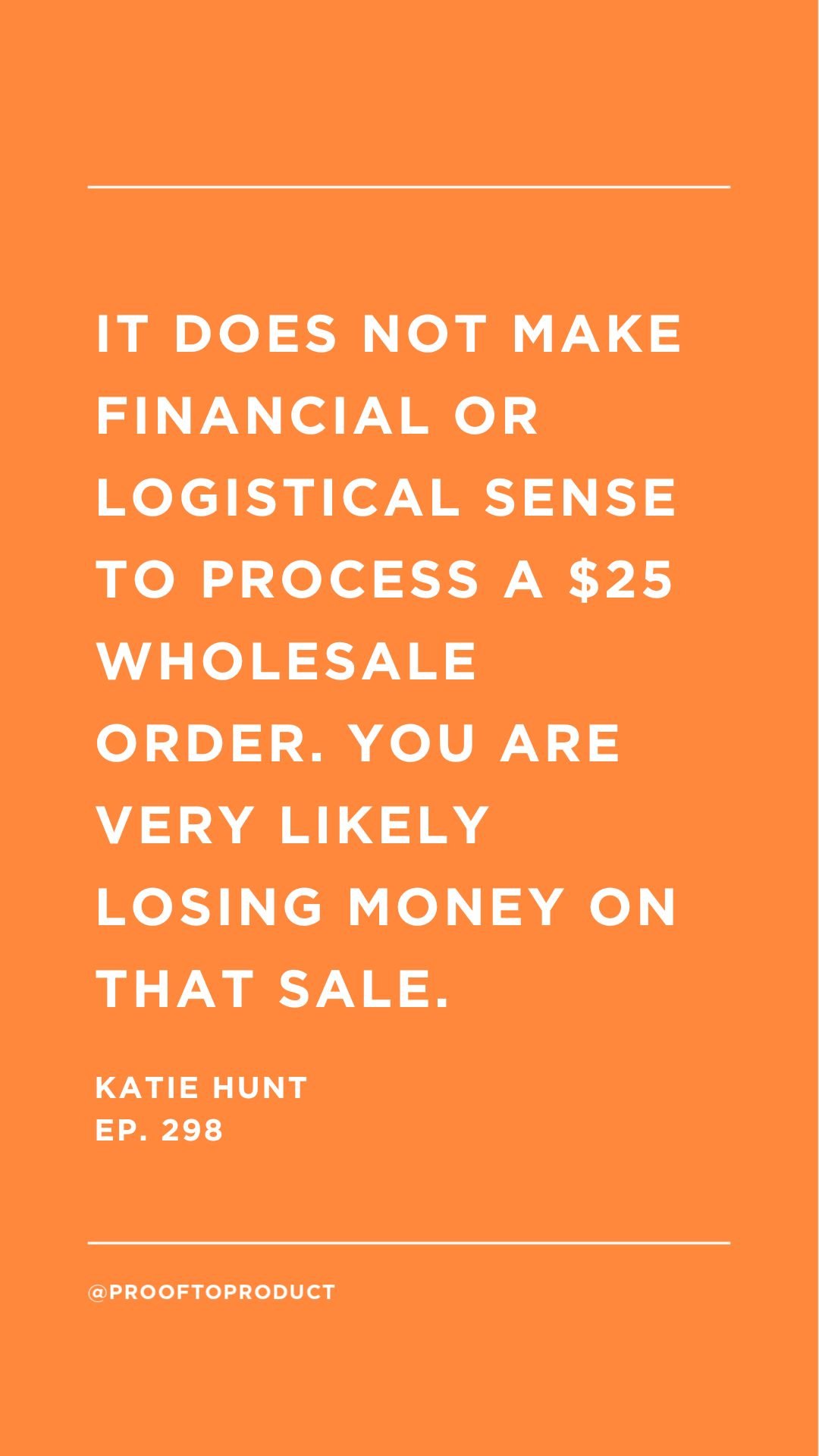
Download These Quotables to Save and Share




Connect with Katie Hunt
Katie Hunt is a business strategist, podcaster, mentor and mama to four. She helps product based businesses build profitable, sustainable companies through her conferences, courses and coaching programs.
Website: prooftoproduct.com | Instagram: @prooftoproduct

you might also like:



In this episode, Katie Hunt walks you through a five-day exercise, about 30 minutes a day, that ends with one clear priority for your quarter and a plan to get there.