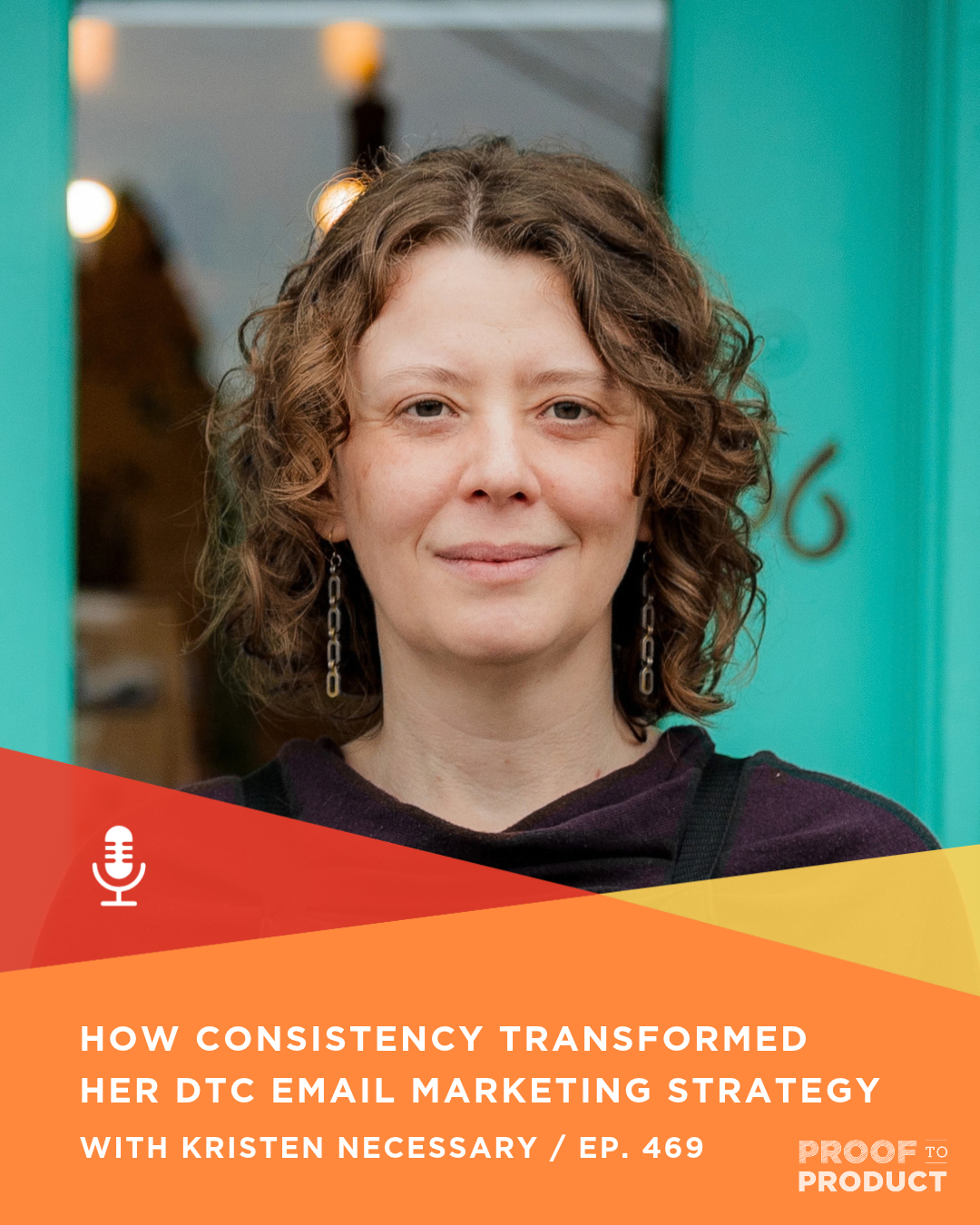
469 | How Consistency Transformed Her DTC Email Marketing Strategy with Kristen Necessary, Starfangled Press
A lot of product business owners know they should be emailing their customers. They also know how easy it is for that email to slide to the bottom of the to-do list.
Kristen Necessary of Starfangled Press hadn't emailed her list in about a year. So she committed to one email a week for a full year, using a simple format she could repeat.
She's now sent 58 in a row, her open rate has stayed above 70% for most of the year, and customers walk into her shop to talk with her about what she wrote.
In this episode, you'll learn:
How Kristen's printmaking background and the idea of the "democratic multiple" led her to make greeting cards and open a storefront studio
Why she moved her cards from hand printing to digital printing, and the rule she kept so the work still felt like hers
How the 100 Day Project, one card a day, helped her add 140 new products in a single year
The three-part email format Kristen uses every week: From the Press, In the Studio, and Around Here
Why sending weekly takes the pressure off, and how unedited, casual photos made her emails easier to send
How posting in the LABS progress logs every Monday kept her accountable, and inspired other members to email their lists more often
Today’s episode is brought to you by our Proof to Product resource library. It’s where you can get your hands on our free resources to help you start, streamline and scale your business in your own way and at your own pace.
MEET KRISTEN NECESSARY
Kristen Necessary is the artist behind the Louie Award-winning brand Starfangled Press. Since 2016 she's been working from a storefront studio in downtown Brevard, North Carolina, where she makes playful, down-to-earth paper goods drawn with an Appalachian accent.
With a background in traditional printmaking, she brings the bold, graphic sensibility of woodcut, screenprint, and etching to her colorful, offbeat illustrations. Her products are carried by shops across the country including Paper Source and REI, and her storefront was described by Southern Living Magazine as a “shrine to paper goods and clever design.”
Kristen believes that original art should be abundant in our daily lives, because art makes life better. Her work is made for folks who know the small things matter, and appreciate the beautiful, funny, and unexpected ways that they connect us to each other and the places we call home.
CONNECT WITH KRISTEN NECESSARY
WEBSITE: https://starfangledpress.com | INSTAGRAM: @starfangledpress
your product brand right now?
Connect with Katie Hunt
Katie Hunt is a business strategist, podcaster, mentor and mama to four. She helps product based businesses build profitable, sustainable companies through her conferences, courses and coaching programs.
Website: prooftoproduct.com | Instagram: @prooftoproduct
-
Katie Hunt [00:00:00]:
Hey friends, welcome back to Proof to Product. I'm your host, Katie Hunt. Today's guest is Kristen Necessary, the artist and owner of Starfangled Press. Kristen's background is in traditional printmaking, and since 2016, she's been working out of her storefront in North Carolina making playful paper goods drawn with an Appalachian accent. She sells through her storefront, through her online shop, and she's in about 60 stores located across the country, including Paper Source and REI. Kristen is a PaperCamp and a member of our Labs community, and she recently completed a fun email experiment that we are going to talk about today. Now in this episode, Kristen shares how 2 similarly structured projects changed how she works. The first one was the 100 Day Project where she created art for 100 days straight, and that led to her adding 140 new products to her product assortment that year.
Katie Hunt [00:01:00]:
The second, which she recently completed, is her weekly So Kristen's D2C list had gone quiet for about a year. They hadn't heard from her for about a year. And so she committed to sending one email a week for a full year. She has now sent 58 emails over 58 weeks. She did not miss a single one, and she is seeing open rates over 70%. Her customers are engaging and buying more from her, and any nerves that she had about sending more emails have gone away. So today's episode is brought to you by our Proof to Product resource library. It's where you can get your hands on a lot of free trainings, workbooks, industry reports, and other resources specifically aimed at helping product-based business owners grow.
Katie Hunt [00:01:52]:
You can get access to that free resource library at prooftoproduct.com/resources. That's prooftoproduct.com/resources. I'm Katie Hunt, wholesale expert, business strategist, and mom of 4. I'm also the host of the Proof to Product podcast. Since 2011, I've coached thousands of brands whose products can be found on the shelves of indie shops and big box stores all around the world. If you are a creative entrepreneur that makes and sells physical goods, you're in the right place. Here on Proof to Product, you'll learn new strategies for product development, sales, marketing, and more. It's like your weekly dose of business school, and we're going to help you confidently grow your revenue in your own way and at your own pace.
Katie Hunt [00:02:43]:
So let's get started. Hey, Kristen, welcome to Proof to Product. How are you doing today?
Kristen Necessary [00:02:48]:
I'm doing great, Katie. Thanks for having me.
Katie Hunt [00:02:50]:
Of course. I'm excited for our listeners to learn more about your business. Why don't you give us an overview about your brand and the many different channels that you sell through? And your brand?
Kristen Necessary [00:03:00]:
Yeah. So my business is Starfangled Press. I make playful, down-to-earth paper goods drawn with an Appalachian accent. My background is in traditional printmaking, so things like woodcut, etching, screen print. I bring that same layered, bold style to all of my illustrations, along with an offbeat sense of humor.
Katie Hunt [00:03:21]:
I love it.
Kristen Necessary [00:03:22]:
I sell my work direct to consumer online, and I also have a small retail shop. And I sell the work wholesale as well. And we're in about 60 stores across the country now.
Katie Hunt [00:03:34]:
That's amazing. So which one of those channels is kind of your top performer right now?
Kristen Necessary [00:03:38]:
The retail store is still the top performer for me. Um, we're slowly growing wholesale and hoping to keep continuing with that.
Katie Hunt [00:03:45]:
Yeah. Well, it's hard to do all the things when you've got your hands in all the different spaces too. Running a shop is a full-time job. Selling wholesale is a full-time job. Selling direct to consumer and other avenues is still a lot of work too. So I was curious, so you do have a printmaking background. What led you down the route of making products and opening the storefront versus maybe something a little more traditional for printmakers?
Kristen Necessary [00:04:08]:
That all really came through printmaking. So I fell in love with printmaking in college. I went to Virginia Commonwealth University and actually ended up going to the University of Iowa to get a master's degree in printmaking. And when I finished up there, I was working with a local nonprofit. I had a solo show there. And with, along with the show, they asked me to teach a few classes. And so I did. And while I was doing that, I started talking to other alumni that stayed in town.
Kristen Necessary [00:04:36]:
And, you know, we all really missed our printmaking equipment that we didn't have access to anymore. And through that, we got together and we opened a community printmaking studio in Iowa City. That's still— Yeah, it was super awesome. And it's still going strong. I'm not there anymore, obviously, but it's been going for 15 years. And while I was doing that, I realized I really wanted to do something similar, but I knew I was gonna move back closer to my home. So when I moved to North Carolina a couple years later, I started to open something similar. And along with my community shop, I was gonna have a small retail space inside of it.
Kristen Necessary [00:05:18]:
And as the business grew, the retail side has grown and grown, and I'm not teaching or sharing the equipment as much anymore. But really, like, printmaking, when I was in school, we talked so much about the democratic multiple and how printmaking is affordable and accessible and bringing art to the masses. And it kind of naturally led into the products I'm making. It was a way for me to even, to a greater degree, put my art out there in the world.
Katie Hunt [00:05:50]:
Yeah, for sure. Especially in such an accessible way, right? Like, you know, greeting cards are a low-entry area to start. And you get to customize that with your own, like, creative thinking and design and, you know, your hands. I know a challenge you shared with me previously was that you were switching your printing by hand to digital printing for some of your greeting cards. I know that was something you grappled with for a really long time. I think we even talked about it in Paper Camp in like the fall of 2020 when you were there. But tell us about that evolution and that decision-making process of trying other mediums and deciding That, that was best for your business?
Kristen Necessary [00:06:31]:
Yeah, I made that so hard on myself. Uh,
Katie Hunt [00:06:34]:
we all do when we overthink things.
Kristen Necessary [00:06:36]:
It didn't need to be so hard. So when I started Starfangled Press, so much of it was about everything being hand printed. And you're right, even when I was in paper camp, I had this pull. I really was interested in switching the cards to digital printing, but I was so torn, like how I reconciled that with what I believed my business to be based on, how I would talk to my customers about it. And I just kept procrastinating on doing it.
Katie Hunt [00:07:04]:
Correct me if I'm wrong, but your identity was also wrapped up in that because you'd been studying printmaking, you'd been teaching printmaking. Like, I'm sure that it was a big decision for you. I don't think you were overthinking it. I think you were just processing.
Kristen Necessary [00:07:18]:
Yeah, it was so hard for me because that was so much about the hand-pulled print. Even though I felt this urge to do something new, to have it digitally printed, It was really hard to move away from that.
Katie Hunt [00:07:31]:
How, how did it impact your business after you did switch over?
Kristen Necessary [00:07:35]:
It's been great, honestly. I wish I hadn't waited as long as I did. Pardon me, but you know, it was probably— it was the right time when I made the switch. I still set up some parameters for myself and how I make the illustrations, so I still draw all of my illustrations in a way that they technically could be printed by hand. And for that was important for me, but the switching to digital has allowed me to have so many more colors, so many more layers than I would've been able to do printing by hand. And it's allowed me to be so much more productive. And most importantly, like, it's been really fun. It let me play around in a way that I couldn't before, or that I was afraid to, cuz there was so much investment.
Kristen Necessary [00:08:22]:
And to work faster.
Katie Hunt [00:08:24]:
That's amazing. Well, and too, with digital printing nowadays, you can also do smaller runs of, you know, even 25 units or something. So it doesn't have to be as huge of an investment. If you are personally hand pulling everything, that's, that's more of a time commitment than a financial commitment too. So there's a give and take there, but—
Kristen Necessary [00:08:44]:
I was going to say it's been so much fun because if I have an idea, I can try it out more easily. There's not that investment of time or materials.
Katie Hunt [00:08:52]:
I love that. You participated in a 100-day project where you created art every day for 100 days. Tell me about this project.
Kristen Necessary [00:09:01]:
So I had tried it a couple times before and not made it through the full 100 days.
Katie Hunt [00:09:05]:
100 days feels like a pretty big commitment to something.
Kristen Necessary [00:09:08]:
Yeah, it really is. So around the time I decided to switch my cards to digital printing, I also did the 100-day project, and for 100 days I drew a greeting card every day.
Katie Hunt [00:09:21]:
Wow.
Kristen Necessary [00:09:22]:
Some of them were more finished than not. I would go back to them and finish them later, but I at least got something on down that day, an idea down.
Katie Hunt [00:09:31]:
Okay. So talk to me about the motivation to doing this. Was it just to kind of get your creativity flowing and, or was the intent to have 100 designs that you could work into a finished product at some point? Like what was kind of your motivation?
Kristen Necessary [00:09:45]:
It really was more about getting the creative juices flowing, getting some work done, not being precious about the work. I knew not all 100 would turn out to be something good. That quantity over quality, and then you find the quality later.
Katie Hunt [00:09:59]:
Did it change your product line at all? Like, did that process change the direction you were heading creatively?
Kristen Necessary [00:10:05]:
Oh, totally. That was really when I had laid out a lot of the new cards. I think I ended up Not from that first 100 days, but that year I added 140 new SKUs.
Katie Hunt [00:10:17]:
Wow, that's a lot in one year.
Kristen Necessary [00:10:19]:
Yeah, it was a lot for me because I was working at a much slower pace beforehand too.
Katie Hunt [00:10:24]:
You know, having been through this process of shifting your print method and going through this creative process with 100 Days, for people that are listening that are struggling through a similar type of, you know, identity tension, maybe, if you will, like, where is my creativity landing? How do I want to be creating these products? What would you tell them?
Kristen Necessary [00:10:43]:
I would say set up some kind of structure, kind of like I did with the 100 days, but allow yourself a lot of freedom within that structure. Like allow yourself to try things out and see, and then look back at it and see what comes out of it. So like for myself, I work with a lot of systems and structures and I find that gives me a lot more freedom because it actually reduces the amount of decisions I have to make.
Katie Hunt [00:11:10]:
So the 100 days was like the parameters in which you could like play in, but you knew, okay, every day I got to create something. It may or may not end up being anything I use in the business, but at least I'm sticking to the schedule and, and paying it, you know, working that.
Kristen Necessary [00:11:24]:
Yeah, that was really fun for me too, because I enjoyed the challenge of every day, okay, what's one thing that I experienced today that others might connect to that I could share with them that might be interesting to other people. Um, that was really fun.
Katie Hunt [00:11:40]:
Yeah, I feel like some— a project like that would be really fun because you're— whether intentional or not, I feel like I would start documenting my days, or like you said, the things that were happening in my day-to-day life would come out through my art in a project like that, which is a fun thing to look back on too and, and think of how we're connecting with other humans.
Kristen Necessary [00:11:58]:
Yeah, and that's really— that's a big way that I approach all of my art. Like I've always approached my art, what I'm making through the experience of my daily life. And it may be the most random thing and it may, a lot of those cards ended up being really silly, but,
Katie Hunt [00:12:15]:
but
Kristen Necessary [00:12:15]:
that's fun. It was fun and they lead to other things.
Katie Hunt [00:12:20]:
Totally. Okay. Let's talk about your email project because one of the reasons I wanted to have you on the podcast here is you have been sharing inside of our Labs program that every week you have committed yourself to sending at least one email to your direct-to-consumer audience for a full year. How many have you sent so far? Where are you at right now?
Kristen Necessary [00:12:42]:
I just sent email 58.
Katie Hunt [00:12:44]:
Okay. I am so impressed by you because that is— it may sound easy for some, like, oh, what's one email a week? But to stay consistent for 58 weeks, you hit your one year. How do you feel about that now?
Kristen Necessary [00:13:00]:
It feels good. Like, I am Like really proud that I made it that far and that I've got this going.
Katie Hunt [00:13:07]:
Do you feel like it's more of a system that you've developed in place? Like, has it gotten easier for you to write and send those emails now?
Kristen Necessary [00:13:13]:
Yeah, definitely. And that was one of my goals too, is just to make it easier on myself.
Katie Hunt [00:13:18]:
Okay. Let me backtrack a little bit. What made you make the decision and to be so specific about a year of one email a week, kind of what was the state of your email list before you started this project? How often were you sending?
Kristen Necessary [00:13:33]:
My email list was in a very poor state. I think it had been, I think it had been a year since I sent an email.
Katie Hunt [00:13:39]:
No judgment here. No judgment. So it had been about a year since you'd sent something?
Kristen Necessary [00:13:43]:
It'd been about a year and I'd been building my list kind of over the 9 years my business had been open at that time. So, you know, there were people on there that probably didn't want to be on there anymore.
Katie Hunt [00:13:57]:
Well, if they hadn't heard from you in a year, they probably didn't even know they were on the list. Exactly.
Kristen Necessary [00:14:02]:
I needed to do some serious re-engagement.
Katie Hunt [00:14:05]:
That's awesome. Okay. So the goal was re-engagement, building the habit, it sounds like, and then also just reconnecting and obviously sales. We want sales to be an outcome of that too. But again, like one email a week for an entire year, it sounds pretty simple, but it is a big commitment. What did your process look like? Did you set aside a certain day of the week to like sit down and write it? Like, how did you kind of create the structure there?
Kristen Necessary [00:14:33]:
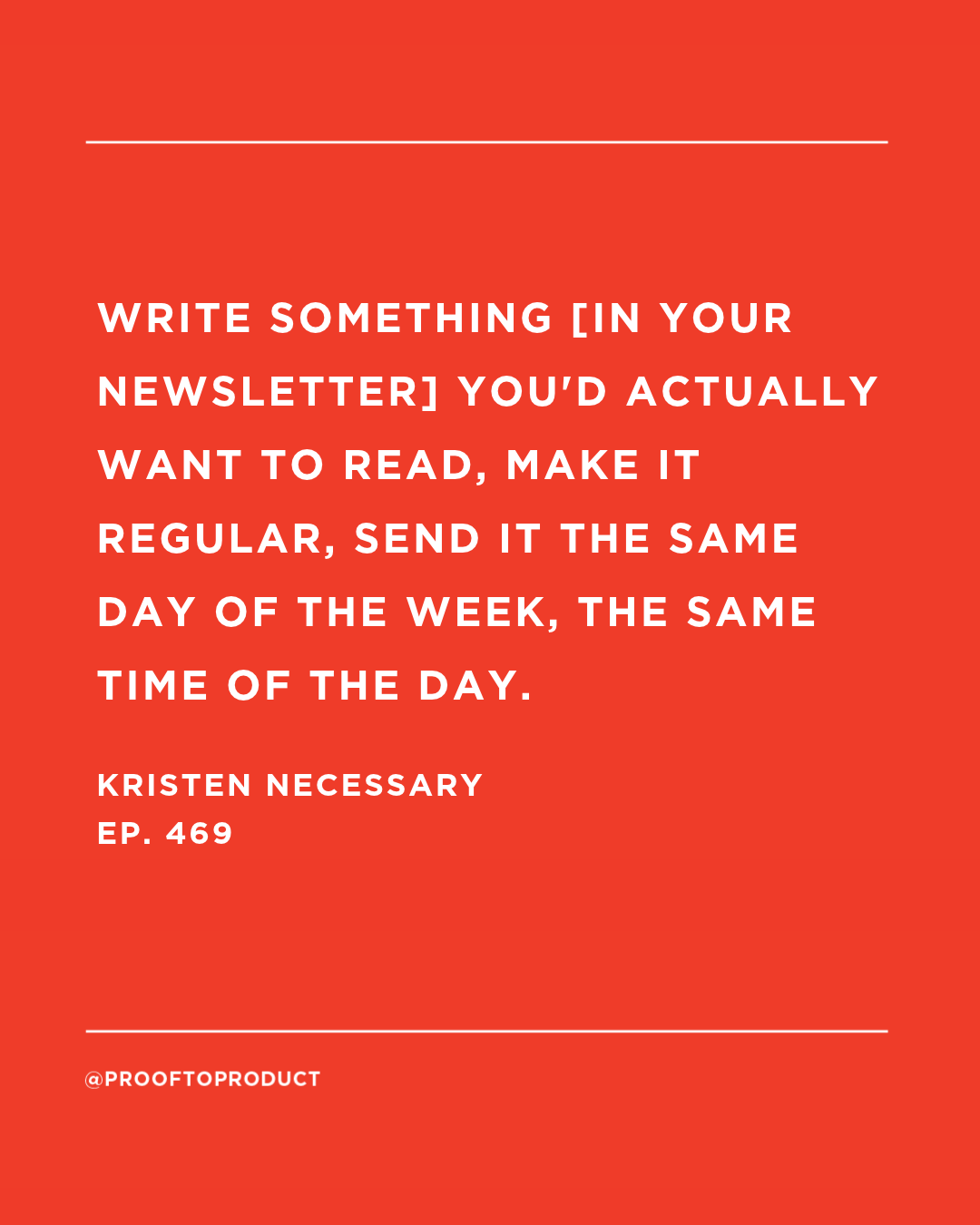
Yeah, so I have a few. So I was thinking back of how I got started on this. It was one of those, like, a synchronicity. I saw a video from Austin Kleon and he was talking about sending your newsletter and he had a few guidelines. He said, write something you'd actually want to read, make it regular, send it the same day of the week, the same time of the day. And use the same format. And then his last advice was don't look at the unsubscribers. I'm still not great at that one, but—
Katie Hunt [00:15:06]:
Don't look at that. I agree with that one. Don't look at that.
Kristen Necessary [00:15:10]:
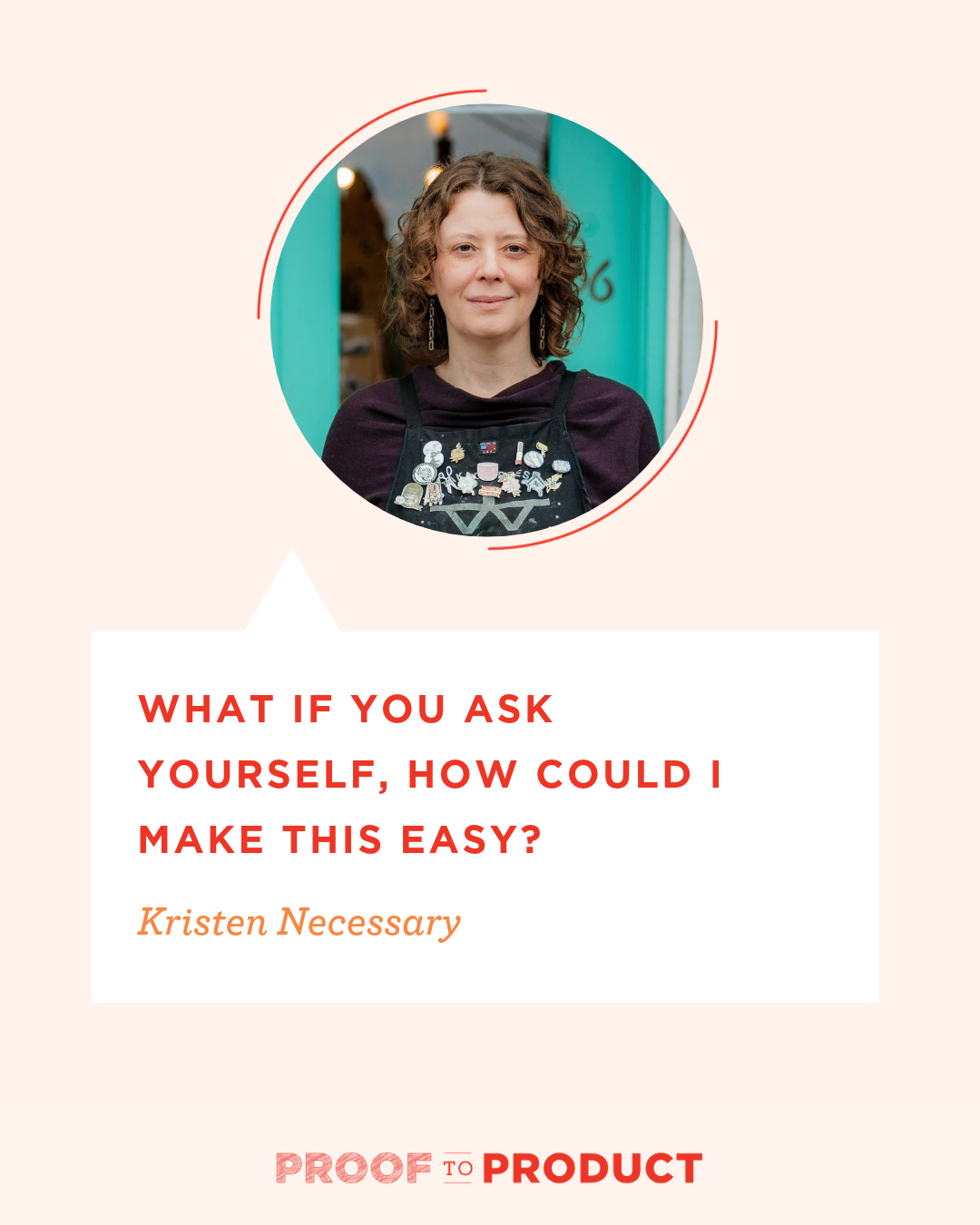
And so along with that, I was reading this book by Oliver Burkeman called Meditations for Mortals. One day, one of the meditations was titled, What If This Were Easy? On the false allure of effort. And that really stuck with me. I love that idea that maybe instead of trying to find the energy or the motivation or the self-discipline to do something that matters to you, like I really wanted to do the email list, but I wasn't doing it. What if you ask yourself, how could I make this easy?
Katie Hunt [00:15:45]:
And so what did you put in place to make it easy?
Kristen Necessary [00:15:48]:
So I've Made a simple structure. I have 3 parts to my email so people can— it's really scannable that way, I think. I hope. The first part is From the Press, where I show a product and talk a little bit about the inspiration I had behind making that product. Then I'll do In the Studio, and I just show a little clip or talk a little bit about something I'm working on, something I'm making. And the last one is my wild card. It's called Around Here. And this kind of anything in my daily life that's influencing what I'm making or something that's happening locally, but I'll let it be anything from a quote to a photograph I took to a recipe I like cooking.
Kristen Necessary [00:16:29]:
So that's been fun for, that's fun for me to share those things.
Katie Hunt [00:16:32]:
Right. I love that cadence of the 3 that makes it real easy for you to kind of plug and play. Like, okay, here's a product, here's what's happening. Here's, you know, something in my life. I love that.
Kristen Necessary [00:16:42]:
Yeah. And it all comes together for me and hopefully for the reader, they can, you know, if they're not interested in one They can just read the ones they are interested in.
Katie Hunt [00:16:50]:
Right. They can scan to the next section. Were you writing ahead for these? Like, were you batch writing so that you, or were you doing them week to week?
Kristen Necessary [00:17:00]:
I still kind of do them week to week, really. I go for a hike a few days a week and I'm usually writing it in my head on my hike.
Katie Hunt [00:17:08]:
I love that. I'm sure you gain a lot of inspiration when you're out there hiking.
Kristen Necessary [00:17:12]:
Yeah. Yeah. I love it out in the forest. And, um, so I'll like, you know, talk to my phone, make some notes. And then come back to the studio and pull it together.
Katie Hunt [00:17:21]:
Oh, I love that. That's cool. Okay, so you're typically doing it week to week. You're not batching ahead of time. What kind of changes did you see to your list over the course of this year of sending one email a year? Did you see any meaningful changes with, you know, things like open rates or your sales data or how subscribers are maybe even engaging with you, responding to things?
Kristen Necessary [00:17:43]:
Obviously restarting a 9-year-old list, I lost a lot of subscribers.
Katie Hunt [00:17:49]:
But that's okay.
Kristen Necessary [00:17:50]:
That's fine. 'Cause I really, when I was doing this, I wanted to connect with people and have a really engaged audience more than having a large audience. So I have a pretty amazing open rate for almost most of the past year. It's been over 70% open rate.
Katie Hunt [00:18:07]:
Kristen, that's phenomenal.
Kristen Necessary [00:18:08]:
Yeah. So like people are reading, people are opening since I have the retail store. It's been really nice too. People will come in person to tell, talk to me about the emails, to tell me that they really love the emails or ask me a question about something I wrote about. So I feel like I'm really building my community and that's important to me. And I love that.
Katie Hunt [00:18:29]:
Definitely. Have you been able to track sales online or sales in the store? I mean, people coming into your shop and saying, hey, I love your emails. That's a great indicator that they're connected and they're engaged with what you're doing.
Kristen Necessary [00:18:41]:
Yeah, that's been a little harder to track because I do see some sales online, but I think most of them are coming in person from the emails because most of those people that come in are buying something also, but I can't really track that.
Katie Hunt [00:18:53]:
Yeah. Yeah. Has there been anything that surprised you about this whole experience, either maybe about yourself as a writer or about your audience, or even just how email can impact how you're connecting with your customers?
Kristen Necessary [00:19:07]:
I don't know. Um, I think I'm surprised how much I've enjoyed it and how I've kept going. You know, I, in my head, I wanted to do this for a year, but now I'm still going. I do question like, am I going to keep it at a week? Do I need to drop it down some? But for now we're still going weekly.
Katie Hunt [00:19:27]:
I think if you're able to keep the weekly cadence, I absolutely would. It's clear that you're, you know, connecting with your customers and too, as more people join your list, they're going to become you know, fans of seeing and hearing from you weekly. I know we have a lot of conversations in our Labs communities and our Paper Camp communities, and there's like a lot of people who get nervous sending emails to their list. They don't want to bother people. They don't want to seem salesy. They don't, you know, they're worried about the perception that comes with sending emails. What do you, having gone through this experience, what would you say to folks that are nervous about sending emails?
Kristen Necessary [00:20:08]:
I think that's a great point to make. I was nervous too. I still get nervous sometimes. The way I approach mine's almost like a letter to a friend, really. But I also, I think the weekly cadence really helped with that because there's not so much pressure. I know that if I make a mistake this week or if I forget to say something, it's fine. I'll just get it next week. I felt like when I tried to do emails monthly, even there was so much more pressure to get everything in the email and to get it perfect.
Kristen Necessary [00:20:39]:
That's with these emails too, on the lines of how do I make this easy? I was thinking a lot about like old school Instagram. I don't edit the photos. I like, I just pop them in there. It's much more casual. It's not super polished. And that So that's more me, it's more authentic, and it makes it a lot easier for me to send this every week.
Katie Hunt [00:21:02]:
Well, I like that you're shaking the feelings of— and I don't know if you actually ever have these feelings, but like, I hear from a lot of folks that the desire to have it perfect or to make sure we're not leaving anything out, or the perfect subject line or the perfect call to action, right? Because we're still running a business, we got to make sure we're sending people somewhere they can buy. And it seems like As worried about that anymore. You're keeping it a little more casual to who you are. You're still communicating well with your customers, but doing it in a way that feels good to you. And clearly it feels good to them because they're staying on and they're, they're paying attention.
Kristen Necessary [00:21:36]:
Yeah, I've absolutely had all of those worries and it tends to shut me down. What I've been realizing is it's much better for me just to go forward and do something imperfectly than to not do it at all. And that's what was happening.
Katie Hunt [00:21:50]:
Oh, I love that. I hope folks that are listening really hear that because I think that imperfect action is how all of us are building strong, sustainable businesses long-term. None, none of us have the answer straight away. And, you know, a lot of things require iteration. It sounds like, I mean, over the last 58 weeks, you've probably done some iterating with the format and everything that you've landed on too, or has it stayed the same all 58 weeks so far?
Kristen Necessary [00:22:16]:
It's stayed the same so far. It's really working for me. Like I said, I work well with that kind of like small limitation that I can be creative within.
Katie Hunt [00:22:25]:
I'm curious if you had— we talked about your 100-day art creation campaign. Now we've talked about the, you know, the 52 emails that you set out to do and you surpassed. There had to have been weeks in both of those projects where you're like, I just don't want to do this. Like, I just don't really feel like it, you know? How did you overcome that? Do you just keep the email a little bit shorter instead of, you know, making it as long? Or how did you kind of push through those days where you didn't really feel like doing it?
Kristen Necessary [00:22:52]:
Yeah, it'll be a little bit shorter sometimes. And that the emails, there's each of my sections is supposed to be pretty short. So far I haven't had any weeks that I didn't, I really didn't wanna do it, but I will say this was the week I almost forgot about it. I was really busy this week and at the last minute I'm like, oh man, you got to send your email. So I had to write it really quick.
Katie Hunt [00:23:15]:
That's funny. But now it's gotten easier that you can write it really quick. You've got the format, you've got the standards, you know, you know, you have things, you always have product you can pull from. You always have stuff you can talk about that's been happening in real life. I like that. Inside of Labs, we have the progress logs, which every Monday we tell people, check in, tell us what you're doing. I'm just sharing for our listeners, you know, tell us what you're working on this week. so that we can check in, hold you accountable.
Katie Hunt [00:23:39]:
And also, it's really, in my opinion, it's really fun to look back at the older progress logs and see what people were working on. And this was one of the things you would post every Monday of like, I'm still working on my weekly email. And it's been fun to see this evolution of now, from the outside looking at you, I feel like you've gained so much confidence through this experiment by, you know, at the front end, you're like, I don't know if I'm going to be able to do this. Like, we'll see. I'm going to commit to it, but we'll see if I'll make it the full year. And And now here you are at 58 weeks in and you're confident, you've got a plan, you've got a system that you're leaning on, and that's worth celebrating. So I want to give you kudos for that. And I want to thank you for allowing us to come along for the journey because you did inspire other people to email their audience more frequently.
Katie Hunt [00:24:28]:
Some are doing more wholesale emails, some are doing more direct-to-consumer emails, but seeing you posting in the progress logs every week. Really inspired a lot of other people to focus on their email too. I don't know if you know that, but I just wanted to share that with you. So thank you for sharing.
Kristen Necessary [00:24:41]:
I didn't. That's awesome. Thank you. The progress log was really good accountability for me too. It kept me going to post in there.
Katie Hunt [00:24:49]:
Because you knew our eyes were all on it going, come on, Kristen, you can do this week too. No, I love that for you. Awesome. Well, having been through this process, what did you learn about yourself or What did you learn about doing hard things in your business, I guess, is another way to phrase this?
Kristen Necessary [00:25:10]:
I think both the 100 Day Project and the email project has really taught me the value of doing a little bit at a time, like consistently. So not relying on big marathon sessions to get things done, but 10 to 15 minutes a day can make such a big difference in your business. And in your artwork.
Katie Hunt [00:25:32]:
I love that. Do you have another big project? Like, clearly we did the 100-day thing. Now we did the 52-week thing. Like, do you have another project like this coming up that you want to kind of tackle or maybe an area of your business you want to focus on with a similar type project?
Kristen Necessary [00:25:46]:
Yeah. So the 100-day project, I've actually done it 3 times now. I'll probably do it a 4th time. I'll start at the beginning of the year. But I don't have any other big projects in line. I'm working on my wholesale pitching and the wholesale emails, but I don't have any numerical goals for that yet.
Katie Hunt [00:26:07]:
Yeah, maybe we'll suss some out with you in Labs when we do see you a week soon, because I think that framework works for you. It keeps— some people it would work really well, some people it wouldn't work at all, but for you it seems like Setting these longer-term goals where you're working on a project in incremental smaller bits, it does lead to major traction at the end. So you could definitely apply something like that to selling wholesale and doing outreach and how many, you know, once a week outreach or whatever it is. So, well, Kristen, this has been super enlightening. I appreciate you coming back to share your story and also just like tell us about the journey of creating the system for your business because I think, you know, Again, email is such an important part of the sales process and our sales strategy, but a lot of people are afraid of sending those emails, or they don't, or they just don't make time for it. It falls to the bottom of the to-do list because there's other things that require their attention. And you prioritize this and you're seeing good results from it, and I really think that's phenomenal. So congrats on that.
Katie Hunt [00:27:09]:
Where can people— let's tell people where they can find Star-Fangled Press online and on socials, and if they want to visit the store, where they can come find you there.
Kristen Necessary [00:27:18]:
Yeah, so we are online at starfangledpress.com, and you can sign up for my email list there as well. I'm on Instagram @starfangledpress, and if you are ever in western North Carolina, we are in downtown Brevard, North Carolina, which is just south of Asheville. It's a great place to visit.
Katie Hunt [00:27:37]:
Phenomenal. All right, Kristen, this was so fun to chat with you. Thank you for coming on and sharing your story with us today.
Kristen Necessary [00:27:44]:
Thanks, Katie.
Katie Hunt [00:27:45]:
Of course. All right, friend, I hope that Kristen's story has inspired you to think about the experiments and the challenges that you can run in your business. Kristen didn't wait for the perfect time to get started, but she did set some parameters. She asked herself, how can I make this process easy? She followed a simple structure and she kept showing up, and that consistency That's what builds your email list. That's what builds your sales and ultimately your business over time. So kudos to Kristen, and thank you for letting all of us in Labs serve as your accountability partners each week as you kept us updated on your progress. It was so fun to see how this project came to be and how it evolved over the year too. Speaking of Labs, friends, if you are looking to build a business that puts more profit into your pocket, then I want you to come join us in Labs.
Katie Hunt [00:28:39]:
This is a space dedicated to helping product founders experiment, learn from one another, and ultimately grow your business in your own way and at your own pace. I emphasize that because all of us are working on different things, but we're all working towards similar goals. In Labs, you will get monthly coaching calls with me, peer masterminds, and co-working sessions. We have our quarterly CEO week and focus sprints throughout the year, plus our training vault of 70 or more different trainings you can dip into and our done-for-you templates. Plus you get a room full of generous product brands who are working towards similar goals. So you can learn more and join us at prooftoproduct.com/labs. That's prooftoproduct.com/labs. Thanks for tuning in today and listening until the end.
Katie Hunt [00:29:30]:
I will be back soon with another new episode.
Today's episode features Kristen Necessary of Starfangled Press where she shares her commitment to send one email a week to her DTC list for a full year, using a simple format she could repeat over and over. She also shares how posting in the LABS progress logs every Monday kept her accountable, and inspired other members to email their lists more often.